Thinking about leaving YNAB?
Let us start with the part most comparison pages will not say: YNAB is a good app. If giving every dollar a job every few days genuinely suits you, you should keep it, and nothing below will change your mind. This page is for the other YNAB user, the one paying for a method they have quietly stopped keeping up with.
How much of your paycheck is actually yours?
Why people search for a way out
The searches that land here are usually about one of two things. The first is price: YNAB runs about $109 a year, there is no free tier, and the price has climbed more than once. The second is the workload, and it is the bigger one. YNAB is not just software, it is a practice. Dollars get assigned when money arrives, transactions get categorized, accounts get reconciled, and when life gets busy for three weeks, you come back to a budget that needs an afternoon of confession before it is useful again.
YNAB people call that afternoon "getting back on the wagon" and the phrase tells you everything. It is a system you can fall off of. Some people are energized by that discipline. A lot of paying subscribers are not, and they are paying for guilt.
What YNAB is actually for
YNAB's method, zero-based envelope budgeting, is aimed at controlling variable spending: groceries, eating out, the categories where the money disappears a little at a time. It is genuinely effective at that, and its envelope discipline has helped a lot of people out of debt. The method asks for daily attention because spending happens daily.
But notice what most of your money actually does: it leaves in large, scheduled, predictable chunks. Rent, insurance, the car payment, the subscriptions. That part of your budget does not need daily attention or a philosophy. It needs arithmetic: which paycheck covers which bill, and how much of the check that just landed is actually yours.
What Atom Budget does instead
Atom Budget starts from your paychecks, not your categories. You put in your bills and your pay schedule, or subscribe and let it read both from your bank statements, and it splits every bill across the paychecks that fund it. When a check lands, you get one number: how much of it is already claimed. The rest is yours, no assigning required.
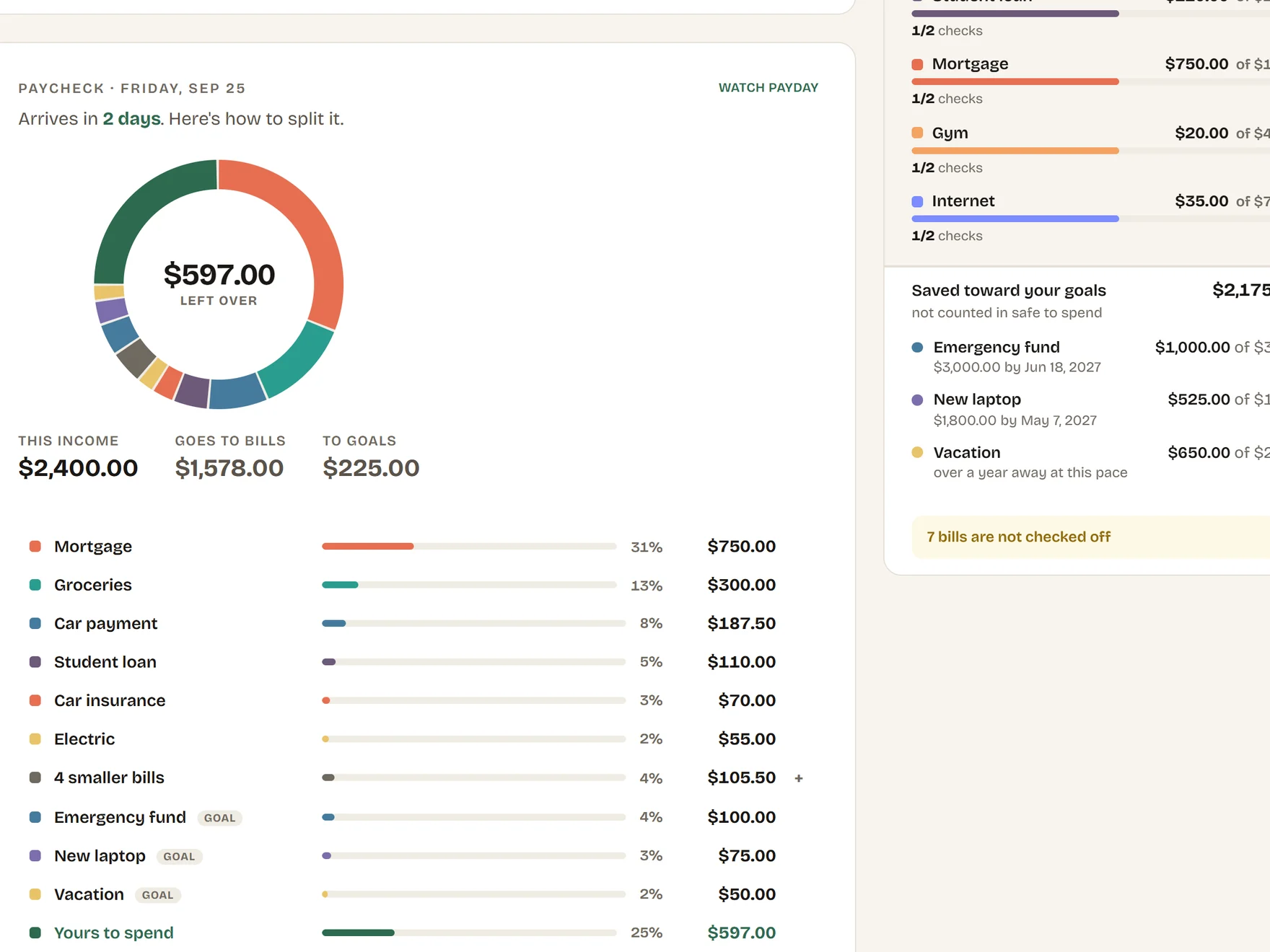
It also keeps a running total of what you should be holding right now toward bills that have not arrived yet, and with a bank connected, it checks that number against your actual balance and tells you plainly when the two disagree. Three-paycheck months are on the calendar before they happen, not a bonus you discover.
The difference in practice: YNAB asks you to check in every day or two, and rewards you when you do. Atom Budget expects to see you on payday. If you disappear for a month, nothing needs reconciling when you come back, because the math never depended on your attendance.
What we do not do
The list is real. There are no spending envelopes here, no stop-when-it-is-empty discipline for restaurants and fun money, no goal thermometers, no debt payoff planner, no categorizing of every transaction, and no community of people cheering your rule-following. If those are the parts of YNAB you love, YNAB is the better app for you, at any price.
Atom Budget answers a narrower question and answers it without homework: what does every paycheck need to cover, and is the set-aside money actually there.
The price difference
YNAB is about $109 a year with a 34-day trial. Atom Budget's core is free, permanently: type in your bills and paychecks and the whole per-paycheck engine works, no card and no clock. The paid part is bank sync, reading your recurring bills from your statements and checking balances automatically, at $8 a month or $80 a year. Cancel whenever you like and everything you imported stays.
Which means trying it costs nothing and switching is not a commitment. A fresh start takes about ten minutes, and your YNAB budget will still be there if you decide the wagon was worth it after all.
Create your free account, or read how the setup works first. Bring your pay schedule and your bill list; leave the guilt.